


Touring Iceland: August 13-15, 2026


Walking through glacial tunnels at Langjokull Glacier:
The most unusual stop of the tour was the Langjokull Glacier. We didn't just walk on the glacier, but inside as well. To walk inside of Langjokull Glacier we were required to wear waterproof shoes. We quickly figured out the reason. In August, the interior is beginning to melt and there were small waterfalls throughout the tunnels. The tunnels are more frozen and drier in December.
It was gray and overcast on the day we visited which prevented us from seeing the surrounding view. We entered the glacier tunnel via a not very elegant tube but once inside and outfitted with shoe chains, we did walk through the man-made glacial tunnels and into the ice caves. This is the largest ice tunnel in the world on the second-largest glacier. Langjokull (the Long Glacier) covers an area of about 950 km2 and most of it is between 1200 and 1300 m above sea level. It was interesting but also spooky.
For those who want a completely unique experience, one of the ice caves was set up as a wedding chapel complete with a heart. As we were leaving a group from the Eclipse Festival arrived in costumes for a party. The partygoers seemed underdressed for an evening in this icy labyrinth.
Hraunfossar and Barnafoss waterfalls:
Our day began with a scenic drive to Hraunfossar and Barnafoss waterfalls. The Hraunfossar waterfalls consist of hundreds of springs of clear water that emerge from under the edge of the lava field (Hallmundarhraun) and flow into the Hvítá river. The width of the falls is about 1 km/.62 mi. The lava field consists of pillow lava and was believed to have formed around 800 AD. Surface water and meltwater from the glaciers runs between the lava layers and emerges to form Hraunfossar falls.
Up river, Barnafoss (Children's Falls) is where the channel of the river Hvítá narrows. The violent force of the water rushing through this narrow channel has sculpted the rocks and carved out bridges and arches. There is an old, tragic story of how the falls got their name and the fate of a stone arch.
One Christmas day the Hraunsás family, except two of the children, went to mass. When the family returned, the children had vanished but their footprints led to the river. The children had fallen off the stone arch and drowned. Their mother had the arch destroyed to protect other curious children.
Þingvellir National Park (modern spelling-Thingvellir):
Thingvellir, one of Iceland’s three national parks, was the site of the first Icelandic parliament: the Alþingi met here from 930 AD to 1798 AD. Lögberg (the Law Rock) was the hub of the Alþing. There, anyone could step forward and speak their mind. Speeches were made influencing the course of Icelandic history; laws were passed and enforced here for over eight hundred years. Thingvellir is designated a UNESCO World Heritage Site.
The boundary between the North American and Eurasian tectonic plates bisects Iceland diagonally, but it is at Thingvellir where the fault or plate drift is most apparent.
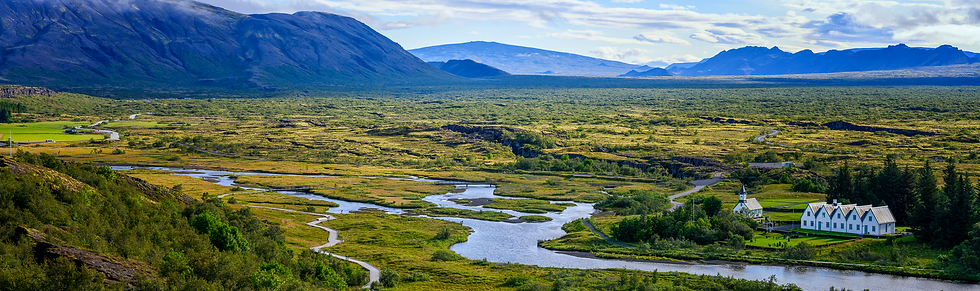
We had perfect weather for walking through a National Park. The first photos were taken from the viewpoint near the parking lot. The area of the first photo is on the North American Plate.

The photo below shows the drifting and the distance between the two plates. The mountains in the distance beyond the church is where the European plate begins. Despite numerous volcanic eruptions, lava has never filled the void left by this ever-widening fault line – the plates are moving apart at a steady rate of about 2cm per year.
As the trail descends from the parking lot, sheer towering rock walls border both sides of the trail. The wooden footbridge is built on top of a rift. It was a gravel footpath until a hole appeared in the middle of the trail in 2011. Subsequent trail work discovered that the fault was about 10 m deep and extended 15 m under the trail toward the southwest. The ravine beneath the trail is narower from top to bottom and was full of large rocks which may have shifted in previous earthquakes. The solution was to build a floating footbridge above the ravine.
There are remains of early stone shelters (booths) along the Oxara river. The booths were used by people during the two-week session of the Alþingi (General Assembly) each summer. New booths were built on the remnants of old booths so what is visible today is mostly from the last two centuries (17th and 18th centuries) of the Alþingi at Þingvellir.
During the time of the Old Commonwealth (930-1262) executive powers in Iceland were very limited. At the Alþingi, laws were enacted, and cases were tried in accord with those laws but verdicts had to be enforced by individuals. For minor cases, fines were imposed while more serious cases might be sentenced to exile for three years or even the person's lifetime (lifelong outlawry). As mentioned in the Sagas of Icelanders if a convicted person flouted the banishment verdict, he might be killed by the family of his victim.
Penalties were made more severe after the "Great Edict" of 1564 which dealt with immoral acts such as incest and fornications. Drowning was a widely used method of execution. At Þingvellir, women were drowned in the Drekkingarhylur (Drowning Pool) or below the meeting place of the Law Council. Women were said to have been tied up in a sack, pushed out into the pool, and held under.
Some Iceland place names are derived from the type of punishment conducted there: Galgaklettar (Scaffold Cliff), Galgi (Scaffold), Hoggstokkseyri (Execution Block Spit), Kagaholmi (Whipping Islet), and Brennugia (Stake Gorge). Brennugia (Stake Gorge) derives its name from the witch hunts of the late 17th century when sorcerers were burned at the state.
Seventy two people were known to have been executed at Þingvellir from 1602 to 1750: 30 males were beheaded, 15 hanged, and nine burned at the stake. Eighteen women were drowned in Drekkingarhylur (Drowning Pool) shown below.

The history of Þingvellir gives insight into how a Viking Age pioneer community organized its society from scratch and evolved towards the modern world where women are elected to the highest offices. The final execution in Iceland took place in 1830, when two people were beheaded for murder. In 1928, capital punishment was outlawed in Iceland. The reintroduction of capital punishment is banned by their constitution.
We stopped at Gullfoss (Golden Falls). Dan and I visited this site in 2014 before it had all the crowds and tourist infrastructure it has now. Gullfoss is the most visited waterfall in Iceland. This is a beautiful, powerful waterfall, but it is a little hard to photograph from the lower trail because of all the mist. The waterfall is located in the canyon of the Hvítá River. It is a two-tiered fall that plunges into a crevice 32 metres (105 ft) deep.
That was the end of our pre-departure tour in Iceland. Our last morning, August 15, we walked around The Pond and other parts of Reykjavik until it was time to board a bus to the airport. It was a beautiful, sunny day.
We left Iceland on August 15 to fly to Nuuk, Greenland, and board MS Fridtjof Nansen for a cruise through the Northwest Passage from Nuuk, Greenland to Nome, Alaska.

Comments