


Cambridge Bay/Iqaluktuuttiaq, Canada: August 29, 2026


Sedna is a legend from Inuit mythology shared across the Arctic regions of Alaska, Canada, and Greenland. The Legend of Sedna:
Sedna was a young mortal woman who refused marriage proposals and was eventually tricked into marrying a spirit disguised as a bird. After her father tried to rescue her, a fierce storm threatened them. Her father threw her out of the boat. As she clung to the side, he cut off her fingers, which transformed into seals, whales, walruses, and other marine animals. Sedna sank to the ocean floor and became the Mother of the Sea, a powerful deity who controls all sea life.
The traditional language of the area is Inuinnaqtun and is written using the Latin alphabet rather than the syllabics of the Inuktitut writing system.
The day we visited the community of Cambridge Bay it was foggy and eventually rainy. The hamlet population is about 1,800, but there are just 385 houses. Winter temperatures are about -60 ℃ which makes it difficult to keep vehicles from freezing. The hamlet has three garages next to the fire department but needs more. Living in the Arctic means it is also a short house building season.
We began with a walking tour that took us to the Hamlet Office where we were welcomed by the mayor. The mayor said getting rid of waste is one of the items they are working on. The barge that shows up once a year to deliver large goods leaves the island empty. They are working on a plan to have the barge remove some of the larger items of waste. They are also trying to get an incinerator for the rest of the garbage. He also talked about some of the outreach programs for disadvantaged youths. One is an art program.
In an attempt to recycle junk that can't be used, The Red Fish Art Center creates metal sculptures. The sculptures are installed around the island and in the Hamlet office.
In the Arctic Inspiration Prize’s 2018 youth category, the participants in Cambridge Bay’s Scrap to Art group picked up a $100,000 prize to open a local welding studio to create art with recycled metal retrieved from the landfill.
The buildings behind the sculptures are in Itqaumavik Park (a place of memories) offering a glimpse of Cambridge Bay's settlement history from the 1950s when families moved in from the land for jobs, services and trading opportunities. This settlement history was shaped by the arrival of the RCMP, the Hudson's Bay Company, the Church, and the establishment of the DEW (Distance Early Warning) Line to monitor Canada's air space during the Cold War.
In the 1950's concerns about northern sovereignty, health conditions, and the administration of social welfare programs prompted the government to construct permanent housing for Inuit to purchase or rent. The government designed a 256 sq ft rigid frame single room structure for $500.00. They were constructed with plywood sheeting and metal walls. These single room houses were furnished with a cot, table, two chairs, sink and an oil-burnign stove.
A former resident remembers living in this house with her family and described it as follows:
"In 1965-1966 we lived in this house with our three sons. We had no running water, no shower nor bath tub and 'honey buckets' as toilets. I remember how cold the house would get when the water tank sitting on a wooden stand inside the door was filled by the water truck. The hose would come through the doorway and even in the middle of winter the door would be opened wide bringing in all the cold air.
We had an area for beds fitting together like a puzzle. A half wall separated our living from our sleeping area. We checked our oil drip stove each night, making sure there was sufficient heating oil so we didn't freeze. We used the stove for heat and for cooking. As long as we had hot water, everything was okay."
The once-a-year barge was in the harbor and had been offloading goods all day. The goods were ordered months ago and now boats, skidoos, vehicles and all manner of merchandise were finally here. One person said that it takes so long to receive the order that it is mostly paid for by the time it arrives.

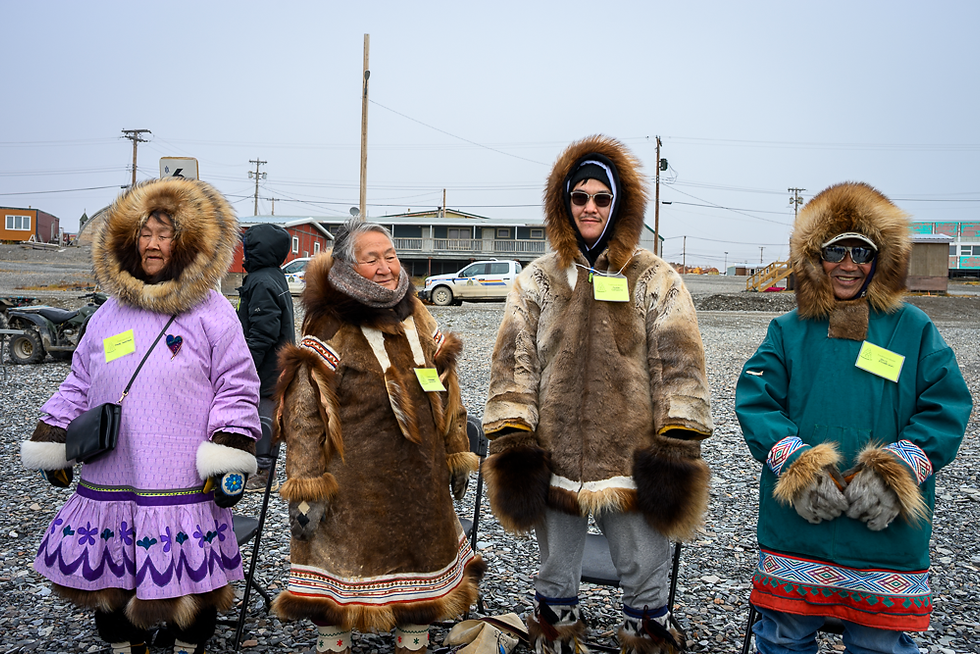
The CamBay Library at the high school is also a museum with a wonderful collection of clothing and other artifacts relating to Arctic Life. There was a large section devoted to the lives of women. There were so many interesting accounts, but I thought the section on pregnancy was very interesting.
In the old days, a woman’s pregnancy was surrounded by many customs and taboos. Mothers-to-be wore amulets of fox bones and caribou teeth so their children would grow up to be fast of foot and good hunters. Pregnant women also had to be careful about eating certain parts of animals, as their babies could be born with similar traits: feet that tripped around like a seal’s flipper, or the hooked and bumpy nose of a goose. Babies were usually born with mothers in a kneeling position while midwives pushed against the stomach. In more difficult births, a shaman would be called in to speak magic words and ensure that the spirits did not prevent the child’s entry into the world.
We toured the Canadian High Arctic Research Station (CHARS). It is a state of the art research facility "designed and built to optimize innovation in Arctic science and technology, to welcome visitors, and to provide researchers with the accommodation and technical services they need. It’s an innovative facility that can support a wide range of research needs – from ecosystem monitoring, to DNA analysis – and where Indigenous Knowledge is recognized as fundamentally important to the co-creation of new knowledge." It is a beautiful and impressive facility that has incorporated Inuit art and themes. There is even a self-serve rotating, hydroponic lettuce tower. Nearby I could hear the sound of Sandhill Cranes and see the Snow Geese.
We had a cabin visit complete with freshly made bannock and a lesson on how to prepare Arctic Char for drying. The cabin belongs to Troy and his family. He has 6 children and 9 grandchildren. Helping him with the demonstration and bannock preparation (no recipe just flour, warm water, baking powder) was his Aunt Amy. Amy had a dish of Arctic Char cracker spread, crackers, dried Arctic Char, and bannock for us to taste. They have a home in the town, but use the cabin for getting out of town and having some space..
The Arctic Char were caught by net in front of the cabin. In preparing the char, Amy uses the traditional ulu and Troy uses a knife.

Troy was from Halifax, Nova Scotia, but found his way to Cambridge Bay, met his wife, married, had children, and now his life is here and he loves it. He is a hunter and told us accounts of Grizzly Bears swimming the 27 miles or so from the mainland to arrive exhausted and hungry in Cambridge Bay. The grizzlies are following the fish that are moving north due to climate change. His feeling was that those grizzlies are more dangerous than polar bears.
Next community visit will be to Ulukhaktok.


Comments