


Sachs Harbor/Ikaahuk, Canada: September 1, 2026


The day began with flat water, a beautiful sunrise, and just a few clouds. As we neared Sachs Harbor, fog fell and didn’t lift much during our visit and return to the ship.
Situated on the southwestern coast of Banks Island in the Inuvialuit Settlement Region, Ikaahuk is the only permanent settlement on Banks Island. Ikaahuk with just 150 residents is one of the smallest communities in the Canadian Arctic.
A young woman named Mariah met the zodiacs as they landed at Sachs Harbor. She had a rifle on her back. She was on the beach to protect us from polar bears as just a couple of days earlier a bear had wandered through the community. She informed us that every home and building had an unlocked door if any of us needed to escape a polar bear.
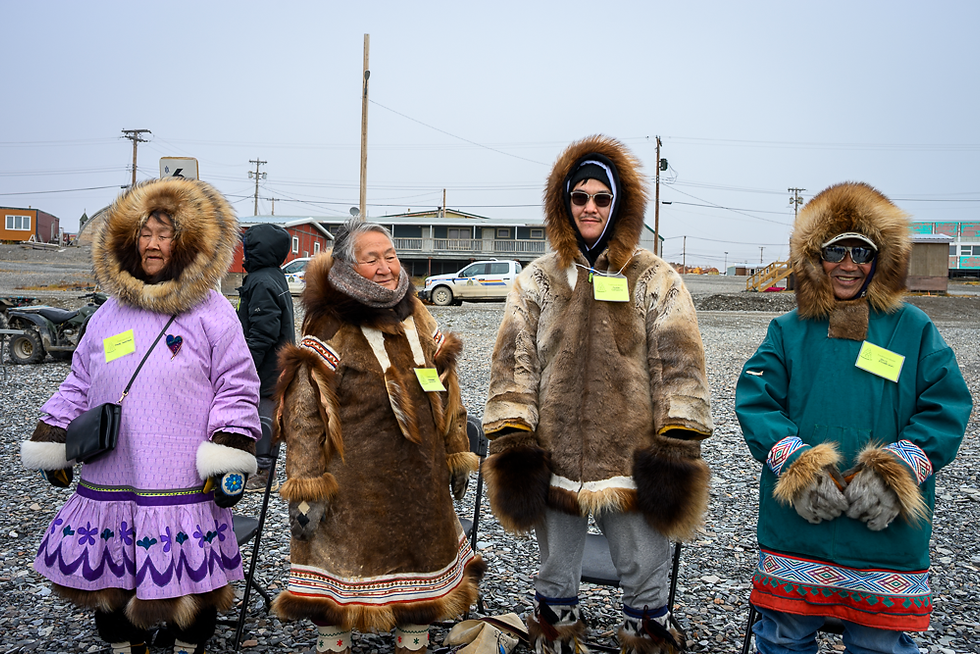
Mariah said she was wearing a Mother Hubbard. A Mother Hubbard parka is a traditional, long-waisted Arctic outer garment featuring a deep, dress-like flounce and a fur-trimmed sunburst hood. The ruff around the Mariah's hood was wolf fur. She shot the wolf herself.
The style was adapted by Inuit and Inupiat women after missionaries introduced cotton fabrics and loose dress designs. It typically includes a wind-resistant cotton over-jacket or shell with a ruffled bottom and an embroidered fur/leather or wool inner lining. Hoods and cuffs are traditionally trimmed with luxurious fur ruffs like wolf, wolverine, or fox to block wind and frost.
We also visited a center where two elders were chatting and telling stories about the origin of place names in this area. They had an arts table with some paintings and handmade fur/leather slippers and boots. The beautiful wall hanging was not for sale.
Sachs Harbor was first visited by the Canadian Arctic Expedition of 1913-18, and was named after that expedition's vessel, the Mary Sachs was beached and dismantled six miles west of Sachs Harbor in 1914. Uninhabited before the expedition, Bank's Island was discovered to be rich in white fox. In the late 1930s, Eskimos from the mainland coast crossing the sea by schooner, began wintering on Bank's Island to trap. Later joined by Eskimos from Victoria Island, they built the community of Sachs Harbor which is now inhabited throughout the year. Trapping remains the basis of the economy, and Banks Island is one of the leading white fox producing regions of Canada and of the world (taken from the Sachs Harbor Monument). Note: the Mary Sachs was a schooner from California.
While the monument states the Banks Island was uninhabited before the expedition, Pre-Dorset cultural sites on the island have been found that date from approximately 1500 BCE. From 1000 to 1450 Thule people occupied several sites along the island, but due to the cooling climate brought on by the Little Ice Age, the island was most likely deserted until the arrival of the Inuvialuit in the 17th century (Wikipedia).
The pieces of iron (a chunk of the Mary Sachs engine block and a part of the cast iron Success stove) on or next to the monument were recovered in July 2013 by Bernard Explorer while searching for the remains of the schooner Mary Sachs.

Arctic hares are the main source of food for Arctic foxes.
Not too far from our landing was the remains of a beluga whale that was caught yesterday. All the meat had been removed at this point. We were told that last year they didn’t get a whale. The whale meat/blubber will be dried and the hamlet will eat from it all winter.
Hunting and trapping are the main source of earning an income. Tourism (this was the first time an HX Expedition ship had visited Ikaahuk) also plays a small role. Residents support themselves through ice fishing and harvesting fish from the Amundsen Gulf and the Beaufort Sea. There is a goose hunt every spring, and the community is also home to the largest commercial muskox harvests in Canada (Wikipedia).
Ikaahuk is our last community visit. I have really enjoyed visiting the communities, chatting with our hosts, and learning a little something about life in the Canadian Arctic.
Next: Exploration days and at Sea days


Comments